
Key Takeaways
- Accurate translation is essential in polygraph examinations because even small changes in wording can alter how questions are understood and answered.
- Interpreter-mediated communication can increase the risk of misunderstandings during pre-test interviews, making comprehension verification a critical part of the process.
- Preserving context, tone, and cultural meaning across languages is often just as important as translating words accurately.
- Additional safeguards, including question reviews, qualified interpreters, and pre-test verification procedures, help protect the integrity and reliability of polygraph examinations.
When a polygraph examination involves individuals who speak different languages, the process becomes more complicated than many people realize. Although interpretation can be useful in improving communication gaps, it may create issues that may impact question clarity, examiner-observee relationship, and test reliability.
To any individual who wants to get the right answers by taking a polygraph test, a slight misconception can produce confusion. Consequently, the issue of language differences should be addressed with caution in order to maintain the integrity of the testing process.
In addition, the interpreter should write all the questions in the required language in order to ensure uniformity and accuracy.
To help you understand better, let us discuss the key challenges of conducting polygraph examinations through language interpretation and why effective communication remains essential throughout the testing process.
Table Of Contents
- Maintaining Question Accuracy Across Languages
- Increased Risk Of Miscommunication During Pre-Test Interviews
- Challenges In Preserving Nuance And Context
- Additional Procedures Required To Protect Test Integrity
- Ensuring Accurate Communication In Polygraph Testing
1. Maintaining Question Accuracy Across Languages
Carefully structured questions are a key part of a professional lie detector test. Each word is chosen for a particular reason, and even slight alterations in meaning can have an impact on the interpretation of a question.
But once there’s a need for interpretation, it can be hard to preserve the original intent of a question. Some words, phrases, or legal terms may not exist in another language. Therefore, an interpreter might have to describe an idea instead of translating the words.
This poses a problem because polygraph tests are based on accuracy.
When a question is translated, the meaning of the translated question may differ slightly from the original, and the examinee may answer a different meaning of the question instead.
In addition, cultural differences can further complicate the situation. A seemingly innocuous word in one language may have different connotations in another. Examiners will, therefore, need to allocate extra time to go over each question with the examinee prior to testing.
2. Challenges In Preserving Nuance and Context

Words are not the only component of language. Communication is facilitated by tone, context, emphasis, and intent. Unfortunately, some of these elements can become difficult to preserve during interpretation.
As an example, an examiner can deliberately word a question in a particular way to rule out ambiguity. However, an interpreter might automatically manipulate sentence structure to make the question sound more natural in the target language.
Even though the change might be considered small, it can change the way the examinee perceives the question.
Similarly, cultural context can influence interpretation. Some of the ideas associated with relationships, workplace behavior, or legal issues may have different interpretations in different cultures. As a result, interpreters should exercise a delicate balance between language and cultural knowledge.
The other issue occurs when the examinee employs some words or explanations that cannot be directly translated into the language of the examiner. In these cases, the interpreter should convey the intended meaning without bringing in personal interpretation. Therefore, maintaining neutrality becomes essential.
3. Additional Procedures Required To Protect Test Integrity
When multiple languages are involved in a polygraph examination, additional variables are introduced, and this may require more preparation and supervision.
Question Review
Examiners may require additional time to read and understand questions prior to the start of the examination. This allows for the translation of the questions to be as close to the original meaning and for the examinee to have a full understanding of each question.
Qualified Interpreters
The qualifications of the interpreter become very significant. Throughout the process, the interpreter should have a good command of both languages, be neutral, and value the importance of accurate communication.
Pre-Test Verification
Additional confirmation measures may be taken by the examiners during the pre-test stage. They may prompt examinees to restate questions to make sure the question is understood before moving on.
Specialized Terminology
Sometimes, terms used in an investigation, employment, or personal dispute context may need further explanation. Thus, sometimes the preparation process can take longer than the normal examination in shared language.
However, when properly managed, interpretation can be used to facilitate effective polygraph tests. The important part is to make sure that communication is clear, consistent and accurate throughout the process.
4. Increased Risk Of Miscommunication During Pre-Test Interviews

One of the most significant aspects of a polygraph examination is the pre-test interview. At this stage, the examiner clarifies the process, checks the questions, and makes sure that the examinee is aware of what will be asked.
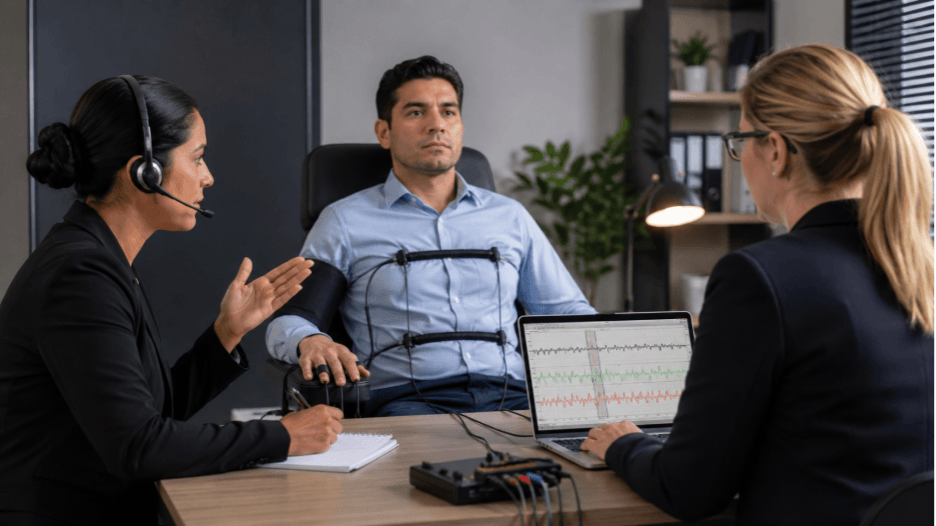
Communication is a multi-step process when there is an interpreter involved. Information is relayed via a third party instead of a direct dialogue between examiner and examinee.
Consequently, certain minute details can be overlooked. As an example, an examiner would pose a follow-up question in order to understand a response. Failure to present that clarification in the right way can lead to the examiner getting partial information.
Also, examiners might not feel comfortable posing questions to the interpreter, particularly on sensitive personal issues. Such hesitation can restrain the examiner from confirming comprehension prior to the commencement of the test.
In addition, successful polygraph testing requires building rapport between the examiner and the examinee. Direct communication is always easier to build trust, but interpretation introduces a new dimension to the interaction and may make forming that connection more difficult.
A 2023 study in Frontiers in Communication supports this concern by revealing that in high-stakes communication, information exchange and interpretation can be influenced by interpreter-mediated communication. The scholars observed that successful communication does not just rely on correct translation but also on maintaining the context and intent in the conversation.
This is the reason why trained examiners attach a lot of importance to ensuring comprehension during the pre-test process instead of presuming that translation alone will ensure comprehension.
Ensuring Accurate Communication In Polygraph Testing
Language interpretation plays an important role in making polygraph examinations accessible to individuals from diverse linguistic backgrounds. However, it also introduces challenges that require careful management.
Question accuracy, pre-test communication, contextual understanding, and procedural safeguards all become increasingly important when an interpreter is involved. Consequently, successful examinations depend on more than translation alone. They require a structured process designed to ensure that every instruction and question is fully understood.
Ultimately, clear communication remains one of the foundations of reliable polygraph testing. When examiners, interpreters, and examinees work together to eliminate misunderstandings, the examination process can proceed with greater confidence, accuracy, and integrity.