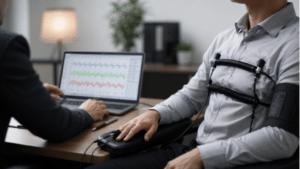


The modern lie detector instrument comprises several essential components, including the psychogalvanometer.
Known variously as the galvanic skin response (GSR) or the electrodermal activity (EDA) sensor, the polygraph’s psychogalvanometer measures changes in the skin’s electrical conductance caused by sweat gland activity. These attachments capture important data that helps in assessing an examinee’s honesty.
GSR sensors were among the components to be integrated into the polygraph instrument. Dating back over a century, these devices have transformed how the modern lie detector instrument captures and visualizes polygraph data.
But have you ever wondered how the psychogalvanometer became an essential constituent of lie detection? Or how the technology evolved over the years?
Well, this post shall unravel GSR’s history and its application in modern polygraphy.
Where Does The Story Begin?
The psychogalvanometer has existed since at least the late 1800s.
Unlike many inventions, there’s no record of a single person developing galvanic skin response sensors. What we know is that multiple physiologists played instrumental roles in its evolution.
The psychogalvanometer has undergone numerous iterations over the years. Thanks to these upgrades, GSR sensors evolved from simple devices to the sophisticated gadget it is today.
GSR is now a vital component of the modern polygraph instrument, collaborating with other attachments to impact lie detector test accuracy.
Early Beginnings
For ages, humans have associated deception with physiological arousal. However, it was not until the late 1800s that the modern polygraph instrument began to take shape.
In 1875, Italian physiologist Angelo Mosso advanced the hypothesis that lying stimulated changes in blood pressure and respiration. Mosso invented a device called the plethysmograph to support his theory.
The plethysmograph became one of the first tools to measure psychological evidence of deception.
Mosso later proposed that lying triggered the autonomic nervous system (ANS), causing several involuntary changes. His very concept underpins the mechanism of modern polygraph instruments.
Emergence of the Psychogalvanometer
In 1879, French therapist Dr. Marie Vigouroux built on Mosso’s theory by founding the study of electrodermal activity in relation to lying.
Vigouroux discovered that deception alters sweat gland activity. This triggers significant changes in the skin’s electrical conductance, providing a reliable way to sniff out liars.
Vigouroux’s works received greater spotlight in 1888, after French scientist Charles Samson Féré discovered that emotions played a critical part in the skin’s electrical responses.
In 1897, German researcher Georg Sticker took things a notch higher by formally suggesting the use of the psychogalvanometer to measure deception.
Twelve years later, in 1909, Swiss neurologist Otto Veraguth deployed the galvanometer for the first time.
Veraguth initially used the galvanometer in word association experiments. After recognizing the device’s potential in measuring deception-triggered emotional arousal, he recommended it for use in more scientific scenarios.
The 1930s and Formal Integration Into Polygraphs
The 1930s became a watershed period for polygraph development. Interest in galvanic skin response grew, with emerging studies corroborating earlier findings about the skin’s role in deception detection.
In the mid-1930s, a Fordham University psychologist named Father Walter G. Summers developed a specialized version of the psychogalvanometer for use in criminal investigations.
In 1938, Leonarde Keeler eventually incorporated the psychogalvanometer into his portable polygraph instrument.
Note that Keeler was a protégé of John A. Larson, who’s widely credited for inventing the modern lie detector instrument in 1921. He updated Larson’s polygraph by integrating GSR sensors, converting it into a sophisticated deception discerning tool.

Relationship Between Skin Conductance and Deception
Psychogalvanometers operate on the premise that deception alters electrodermal activity.
Lying activates the autonomic nervous system, leading to the “fight-or-flight” response. This causes an involuntary spike in perspiration, which EDA sensors capture.
Increased skin conductance signals higher physiological arousal, pointing to potential deception. The converse is true.
How Do Psychogalvanometers Work?
The psychogalvanometer comes in pairs of small metal plates or sensors. Before conducting a lie detector test, an examiner secures each electrode to any part of the body (often the palm).
Small Velcro straps typically hold the sensors in place, preventing shifts during the evaluation. The Velcro straps hold the psychogalvanometer firmly onto the fingers, without exerting extreme physical pressure.
Thin wires extend from the tip of each finger to the polygraph instrument.
Whenever an examinee replies to a polygraph question, the psychogalvanometer captures and transmits any electrodermal changes to the polygraph instrument. Examiners later analyze the chart (alongside other datasets) to infer deception or honesty.
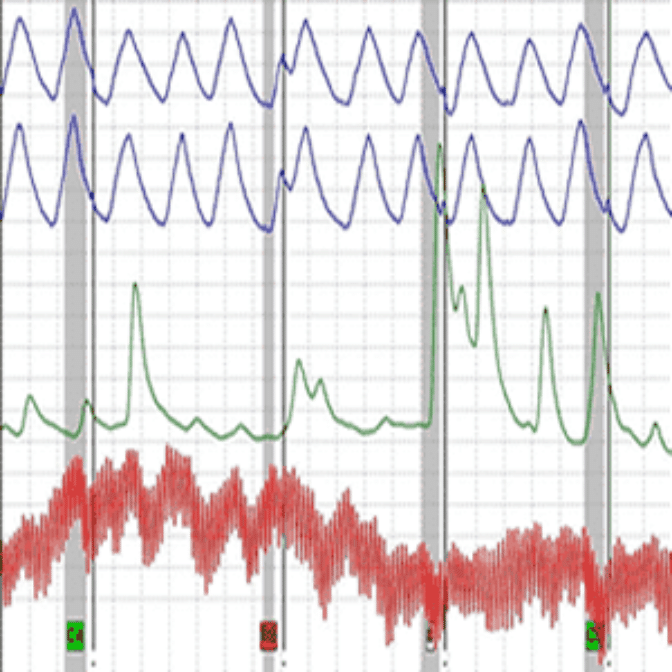
Other Important Polygraph Data Acquisition Components
The polygraph instrument utilizes other essential devices to collect an examinee’s data, besides psychogalvanometers. They include pneumographs and cardiosphygmographs.
Pneumographs measure respiratory activity. They also come in pairs, one wrapping around the thoracic area and the other going around the abdominal cavity.
Meanwhile, cardiosphygmographs track various cardiovascular variables during polygraphs – blood pressure, pulse rate, and heart rate.
Significance of Acquaintance Testing
An acquaintance test has become an inseparable part of modern polygraph evaluations.
Also known as stimulation testing, acquaintance testing ensures the various polygraph components are functioning properly before embarking on formal questioning. It involves an examinee lying about a trivial matter totally unrelated to the case under investigation.
Acquaintance testing typically occurs during the pre-test phase. Examiners can utilize this opportunity to calibrate the psychogalvanometer while also recording the examinee’s electrodermal baseline data.

Acknowledging the Psychogalvanometer’s Role in Conducting Accurate Polygraphs
The psychogalvanometer was among the first inventions to find its way into the polygraph instrument. It remains a critical component of lie detector equipment, thanks to emerging studies linking electrodermal activity with deception.
But as noted, the psychogalvanometer doesn’t work in isolation.
EDA sensors collaborate with other essential polygraph devices, including pneumographs and cardiosphygmographs, to collect quality physiological data during polygraph questioning.