
Key Takeaways
- Truth-verification services that work independently are most useful where there exists controversy with regard to particular facts.
- Issues where there are conflicting claims and little evidence may be considered suitable for verification testing.
- Clear and concise questions increase the chances of success.
- Impartial assessment could go a long way in reducing uncertainties in both private and official settings.
- How effective the entire exercise turns out to be largely depends on careful preparation and question selection.
Where critical questions are left unanswered, doubt can lead to stress, conflicts, and hard choices.
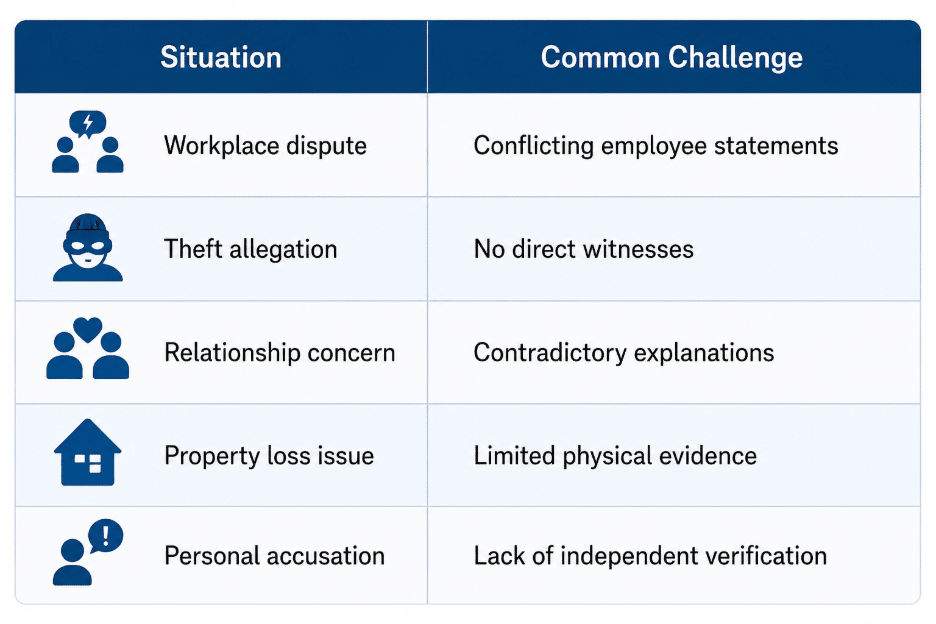
Regardless of whether the problem lies in personal relations, an office dispute, allegations of robbery, or a legal issue, conflicting stories can sometimes make it impossible to tell what really transpired.
Often, evidence that can confirm or disprove claims is inadequate or insufficient in such circumstances. This is why people try various approaches in order to obtain additional proof and ensure that they have reliable information to work with.
Truth verification services such as a polygraph exam (Lie detector testing) offer a systematic and unbiased way to resolve such issues.
Knowing what cases can benefit from such an approach can help you decide whether this kind of service can be used for yours.
The following points describe five common features of cases that fit well with truth verification procedures.
Table of Contents
- There Is a Clear Dispute About a Specific Event
- Available Evidence Does Not Fully Resolve the Issue
- The Person Being Examined Is Willing to Participate
- An Independent and Objective Evaluation Is Needed
- Outcome Could Influence Important Decisions
- When Clarity Matters the Most
1. There Is a Clear Dispute About a Specific Event
One of the key prerequisites of effective lie detector testing is the presence of some clear factual issues. It is essential for the process to be effective when there is a particular action, incident, or statement that should be verified.
In such cases, there could be some accusations related to money theft, leaking of private information, breach of agreement, provision of false statements, etc. Here it will be relatively easy to identify the key issue in question and study it.
An explicitly stated factual issue enables the polygraph examiner to formulate the questions directed at it. If the issue is rather vague and does not involve factual problems but rather some broader issues, it will be quite hard to obtain any significant results.
The narrower the formulated issue, the better results one should expect from lie detection testing.
2. Available Evidence Does Not Fully Resolve the Issue
Most often, cases are brought forth where evidence is present but incomplete. Different pieces of documentation, statements, reports, and other kinds of evidence can contradict one another, raising certain questions.
In such instances, truth verification agencies become a supplementary means of investigation and assessment of conflicting facts.
Where there isn’t enough factual basis for making a judgment from traditional methods of proving something, people will always strive for more details and facts to enable the decision-making process.
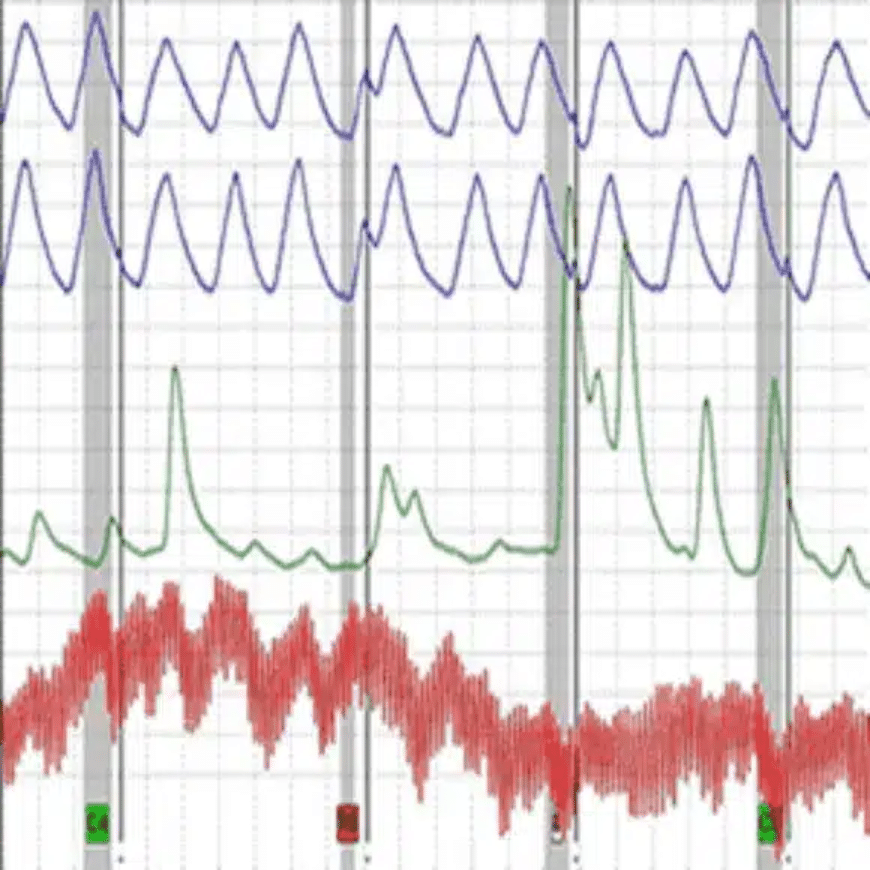
Research also supports the use of validated truth-verification methods in disputed cases. A 2021 meta-analysis published in Applied Cognitive Psychology found that validated polygraph methods can reliably distinguish between truthful and deceptive responses. These findings suggest that truth verification may provide valuable insight when conflicting or incomplete evidence leaves important questions unresolved.
As a result, cases involving incomplete, contradictory, or inconclusive evidence are often among the strongest candidates for independent truth verification services.
3. The Person Being Examined is Willing to Participate
Independent truth verification services are most effective when the person being examined agrees to participate voluntarily.
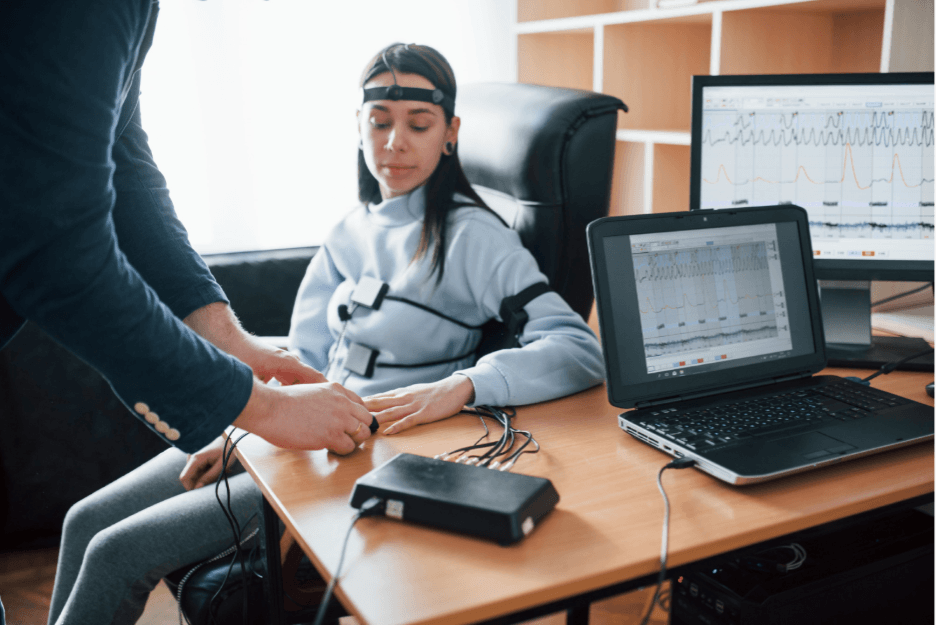
Polygraph examinations require cooperation throughout the process, including the pre-test interview, question review, and testing phase. When an individual willingly participates, the examiner can establish clear communication, explain the procedures, and ensure that all questions are fully understood before the examination begins.
Voluntary participation also helps maintain the integrity of the examination. Individuals who understand the purpose of the process and agree to be tested are generally more engaged in providing accurate information and following the examiner’s instructions. This creates a more professional testing environment and supports the collection of reliable physiological data during the examination.
In contrast, situations involving coercion, intimidation, or unwilling participation may complicate the testing process.
Independent truth verification services are designed to provide objective information, not to force cooperation. Therefore, cases where all parties understand the purpose of the examination and the examinee willingly agrees to participate are often better suited for professional truth verification
4. An Independent and Objective Evaluation Is Needed
Many cases often become complicated since the individuals involved have something emotionally, financially, or professionally at stake in relation to the dispute.
In such a case, with increasing levels of conflict, it could get more difficult for either of the two sides to be able to judge the case objectively.
Verification of truth by an independent entity involves using a Polygraph Test that is not related to any individual opinion held by the disputing parties.
This neutral form of examination can be useful in many different scenarios where there are conflicting interests, such as in disagreements within relationships, families, the workplace, businesses, cases involving criminal defenses, or anything to do with immigration.
The benefit here lies in the fact that this process will follow the same guidelines no matter who is involved.
5. Outcome Could Influence Important Decisions

Truth verification is a process that is more relevant for use in situations where the facts to be examined have some kind of significance.
In most instances, the reason why people opt for truth verification is due to the fact that they have to make a crucial decision and yet do not know much about the facts. In such cases, people want to decide whether they should continue their relationship, resolve some issues at work, pursue a certain strategy legally, etc.
If the decision is significant, then having access to more information can be helpful in eliminating any uncertainty.
As examples, we can consider a situation where a person has to take action regarding an accusation at the office, check whether the other party is being dishonest with them, check some allegations of theft, help prepare a case for court, etc. Here, too, access to more information can assist people in making decisions.
However, at the same time, one has to understand that different examinations, such as polygraph tests, require proper case selection and formulation of questions and professional examination administration.
When Clarity Matters the Most
Truth verification by independent truth verifiers is more meaningful when issues that need answers remain open-ended, and traditional forms of evidence can’t guarantee that the information at hand is true.
Where disputes are involved and where issues of high importance are being considered, it would be prudent to conduct independent truth verification in order to add further clarification to the matter.
Though no one process can supersede the need to carefully review all relevant information, a polygraph may prove helpful in such instances.