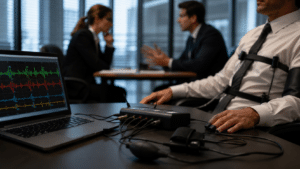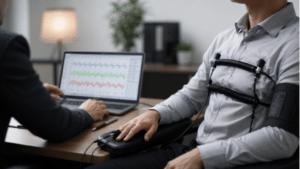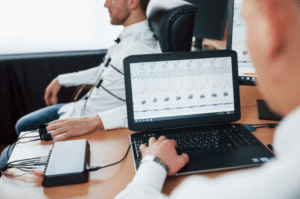

In polygraphs, baselines denote the initial physiological readings recorded when subjects respond to neutral questions. They reflect the examinee’s normal physiological state, providing a solid benchmark for gauging their responses to in-test questions.
Baselines impact the success of lie detector tests. While polygraph exams are not 100% accurate, the error margin reduces significantly with accurate baseline data.
But how are baselines established, and what role do they play in upholding polygraph’s credibility?
What Do Polygraphs Measure?
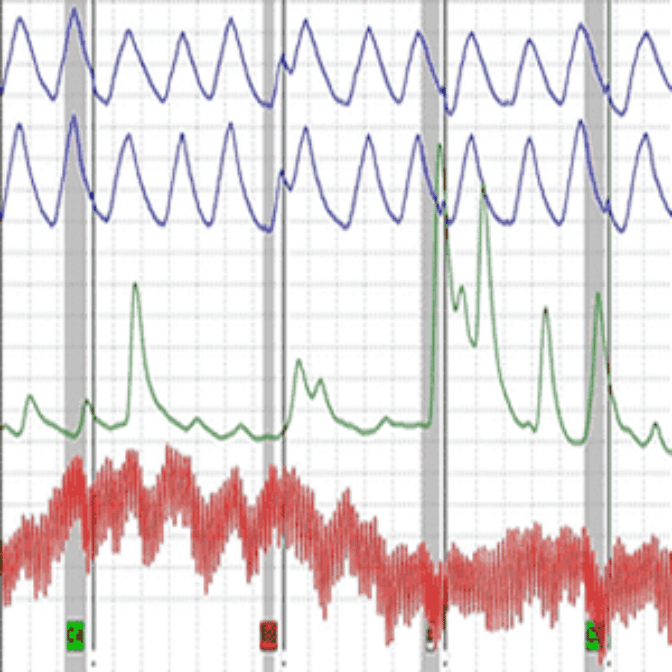
Polygraphs measure fluctuations in physiological reactions controlled by the autonomic nervous system (ANS), which are synonymous with deception. The lie detector monitors the following responses;
- Cardiovascular activities (heart rate, pulse rate, and blood pressure) – All of which spike when we lie
- Respiratory activity (including breathing rate and volume) – Which becomes deeper and shallower
- Skin conductivity – Which rises due to increased perspiration
Further, the American Polygraph Association (APA) requires modern polygraph tests to incorporate motion detectors. These sensors are typically integrated into an examinee’s chair, picking up subtle motions indicative of deception.
Unveiling the Role of Baseline Data
Our physiological functions are constantly in motion. To infer deception during polygraph tests, we must gauge the responses against a reference point. That’s where baselines come in.
Baselines provide examiners with a standard for comparing the magnitude of physiological reactions when examinees respond to in-test questions. Deviations beyond certain thresholds may denote deception or honesty, depending on the question types involved.
Other functions of baseline data include;
- Helping with proper equipment calibration
- Basis for performing acquaintance testing
- Helping account for artifacts that may trigger deception-linked responses, such as involuntary coughing, eye movements, and fidgeting
When Are Polygraph Baselines Collected?
A standard polygraph exam lasts 90 minutes to 2.5 hours. The entire session typically unfolds in three distinct phases, including;
- Pre-test Phase – For preliminary investigations and rapport building
- In-test Phase – Accounts for much of the Q&A session
- Post-test Phase – For report compilation and scoring
The pre-test phase is where examiners collect baseline data.
Before attaching various polygraph sensors to an examinee’s body, a polygrapher will engage the subject in a robust interview. The pre-test interview helps establish a rapport, discuss the case at hand, and seek the examinee’s consent.
Examiners also inform examinees of how the procedure works to minimize in-test nervousness.
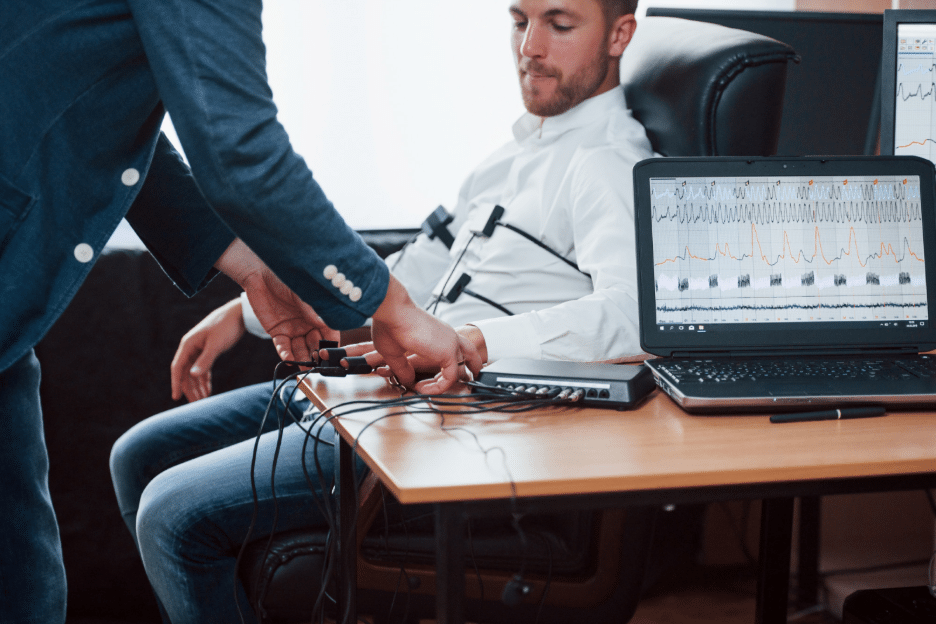
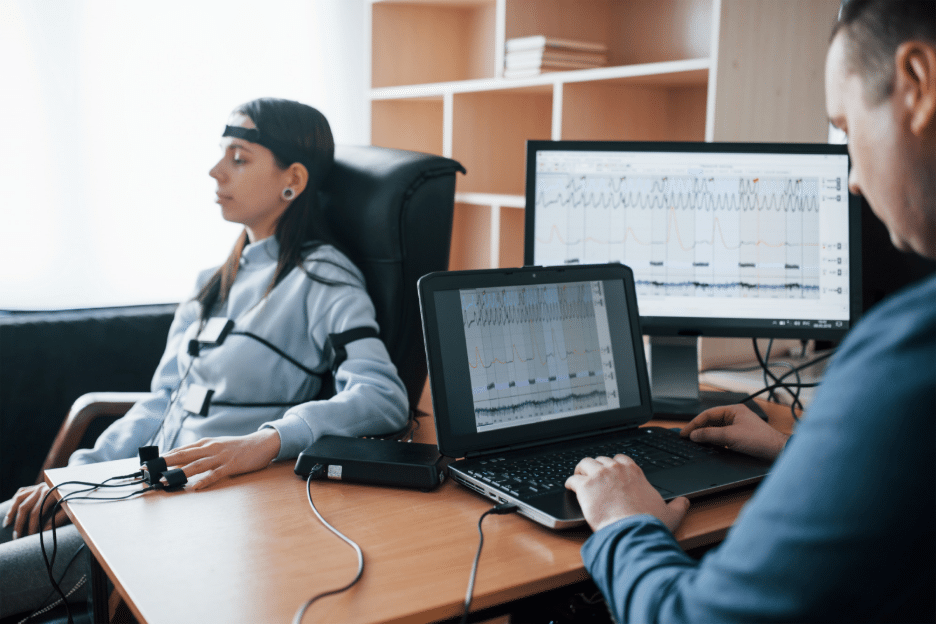
Next, the examiner connects the distinct polygraph attachments to the examinee’s body. Those include;
- Sphygmomanometers – For measuring cardiovascular changes
- Pneumographs – For tracking respiratory rate and volume
- Electrodermal sensors – For monitoring skin conductivity
The examiner proceeds to pose a series of neutral questions. Typically, these are basic or general knowledge questions that are totally irrelevant to the case at hand.
Examples include;
- Is your name Bill?
- Is Chicago your hometown?
- Are you presently in a room?
As these questions evoke no emotional stress, each response highlights the examinee’s normal physiological state. It’s worth noting that individual physiological baselines can vary by factors like;
- Genetics
- Emotional disposition
- Environmental aspects, such as glaring lights and unsettling sounds
- Medical conditions, particularly cardiovascular disorders, respiratory issues, or skin problems
- Substance abuse
- Fitness level
Examiners must consider these mitigative factors while recording a subject’s baseline data.
Questions should also be framed clearly and empathetically to minimize nervousness. Besides, the test must happen in a neutral environment free from spatial bias.
How the Polygraph Instrument Records Baselines
1. Sphygmomanometers
Sphygmomanometers are a polygraph attachment with blood pressure cuff monitors on one end.
Each time an examinee responds to neutral questions, the device transmits their resting heart rate and blood pressure back to the polygraph instrument.
2. Pneumographs
Studies have established marked respiratory changes in response to deception, including increased shallow breathing. Pneumographs measure these fluctuations.
Each polygraph machine comes with two pneumograph tubes – one for the upper chest and the other for the abdomen.
The first tube captures breathing rate and respiratory amplitude on the upper chest, while the other monitors those variables around the abdomen. Both metrics register on the polygraph instrument with each response to neutral questions.
3. Electrodermal Sensors
Electrodermal sensors record skin conductivity changes due to increased sweat gland activity. To measure skin conductivity, examiners attach metal plates onto an examinee’s fingertips or use stick-ons that attach anywhere on the arms.
Most people record normal electrodermal activity (EDA) ranging from 1 to 20 microsiemens. Dramatic shifts from this baseline, coupled with other physiological deviations, may suggest deception.
Harnessing Baseline Data
With the baseline data duly collected, the polygraph exam proceeds to the in-test phase.
Examiners pose a series of Relevant and Control questions. When an examinee responds, the various polygraph sensors record their physiological reactions in real time.
Examiners allow for about 15 seconds between the questions for the subject’s physiological functions to revert to a state of homeostasis.
After asking all the questions, the test proceeds to the third and final phase – the post-test.
Examiners compare responses to the in-test questions against pre-recorded baselines. A higher magnitude of reactions to Relevant questions suggests deception, while stronger responses to Control questions indicate truthfulness.

Underscoring Role of Baselines in Credible Polygraph Tests
Credible lie detector tests hinge on accurate baselines. Using the pre-recorded physiological data, examiners can compare responses to Relevant and Control questions to infer truthfulness or deception.
Baselines may also assist examiners in calibrating the polygraph instrument. Besides, responses to in-test questions can help examiners pre-qualify the examinees for the subsequent phases of the polygraph test.
We should point out that baseline data isn’t a distinct numerical expression. Rather, it’s a dynamic state that represents an examinee’s ANS behavior under non-stressful conditions.
To capture accurate data, examiners must conduct robust pre-test interviews. Questions should be neutral, communication clear, and the testing location comfortable.