

One of the most pervasive lie detector myths concerns their accuracy.
On the one hand are staunch proponents who hold that polygraphs can be nearly error-free if professionally administered. Yet, on the other hand, skeptics readily dismiss the technique as a sheer waste of time.
But how accurate are lie detector tests, really?
Well, there’s no cut-and-dried answer to that question. While the American Polygraph Association (APA) outlines the criteria for conducting credible polygraph exams, numerous variables can impact the outcome.
Here’s everything to know about lie detector test accuracy and the principal factors affecting polygraph outcomes.
What Does A Lie Detector Test Actually Measure In Your Body?
Understanding the science behind polygraph exams is important before requesting the procedure.
Contrary to what it implies, a lie detector test doesn’t literally tell when someone is being dishonest. Instead, the technique measures certain variables associated with deception.
The lie detector test is premised on the fact that deception exerts high cognitive load.
When we lie, the brain registers the action as a threat and activates the Autonomic Nervous System (ANS). The ANS responds by inducing a series of involuntary physiological reactions to combat the threat.
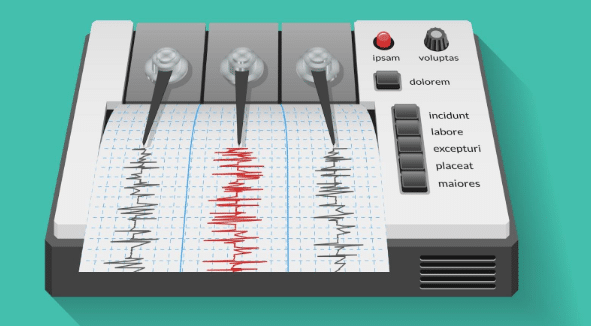
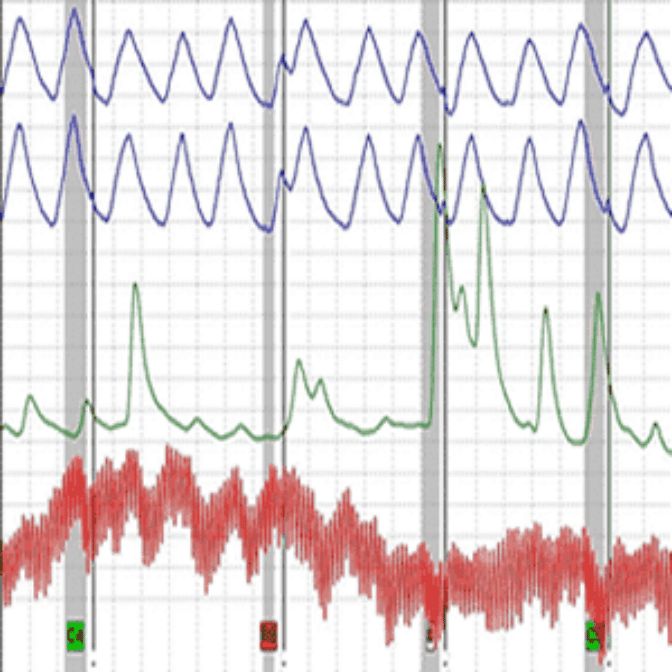
Polygraphs specifically measure changes in:
- Cardiovascular Activities: Blood pressure, heart rate, and pulse rate all spike when we lie
- Respiration: Shallow or deep breathing may indicate deception
- Skin Conductivity: Increased sweating is generally synonymous with lying
- Motion: Untruthful examiners may twitch randomly or get fidgety while answering questions
How Does a Lie Detector Test Work: Step-by-Step
Pre-Test Phase
I. Examiner reviews the facts of the case.
II. Examiner sets up an interview with the would-be examinee.
This interview helps build rapport and explain the case at hand. Besides, the examiner utilizes the opportunity to assess the subject’s physical and psychological suitability for the test.
III. Examiner obtains examinee’s informed consent in writing.
IV. Examiner prepares a list of in-test questions, and both parties review them.
V. An acquaintance test is conducted to establish the examinee’s physiological baselines and calibrate the polygraph instrument.
In-Test Phase
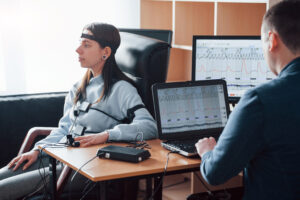
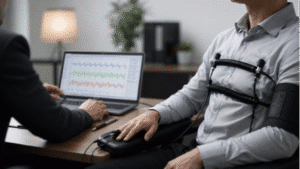
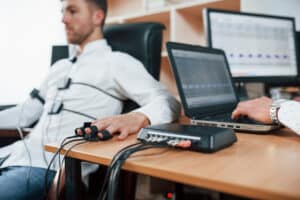
I. Examiner attaches various sensors to the subject’s body, namely;
- Blood Pressure Cuffs: Wrapped around the arm to monitor cardiovascular activity.
- Pneumographs: Placed around the chest and abdomen to track breathing rate and depth.
- Galvanic Skin Response (GSR) Sensors: Attached to the fingers to measure sweat-induced skin conductivity.
- Motion Sensors: Placed on the subject’s chair to capture physical motions.
II. Examiner asks a series of questions using validated forensic standards as the examinee responds Yes or No.
Post-Test Phase
I. Examiner evaluates the magnitude of deviation in the subject’s responses to the in-test questions against the pre-recorded baseline data.
II. The subject is allowed to explain some of their responses.
II. Examiner compiles the final polygraph report, with one of the following scores;
- Deception Indicated (DI)
- No Deception Indicated (NDI)
- Inconclusive (INC)
What Does Research Say About Lie Detector Test Accuracy

According to the American Polygraph Association, single-issue polygraph tests can be up to 95% accurate, with 89% as the aggregated decision accuracy.
Single-issue lie detector tests are event-specific, focusing on particular occurrences like workplace thefts.
Multiple-issue screening has a lower accuracy score (sometimes down to 64%) because it covers broader aspects.
Can a Lie Detector Test Give a Wrong or False Result?
Every polygraph exam includes some error margin, which explains why the process may give a wrong or false result.
Examiner competence is the biggest factor impacting lie detector accuracy.
To stay safe, seek out examiners who graduated from APA-accredited programs. The individual must also follow standardized procedures in designing polygraph questions.
Each in-test query must;
- Elicit a flat Yes or No reply.
- Be neutral and not accusatory.
- Be reasonably clear and concise.
- Be asked multiple times.
Other factors that could impact polygraph accuracy include;
- Subject’s Physical State: Fatigue, drowsiness, etc.
- Medical Impairments: Neurological disorders like Parkinson’s disease, alcohol intoxication, etc.
- Environmental Factors: Uncomfortable rooms, visual distractions etc.
Is It Possible to Trick or Beat a Lie Detector Test?
It’s nearly impossible to trick a professionally administered polygraph exam.
First, the polygraph instrument measures physiological reactions that are difficult to manipulate. Besides, examiners are trained to detect countermeasures.
Your best bet is to remain truthful throughout the test, despite the stakes.
Using countermeasures (whether to beat a polygraph exam or reinforce your truthful answers) can be grossly counterproductive.
Upholding Your Reputation With Credible Polygraph Tests
Polygraph exams cannot be 100% accurate. While this technique relies on involuntary physiological functions to measure deception, the results almost always have some error margin.
That said, a professionally conducted lie detector test can achieve impressive accuracy scores of up to 95% (for single-issue testing). If you’re planning to take a polygraph exam, be sure to work with an experienced examiner.
Polytest.org maintains a global network of APA-accredited examiners to ensure every lie detector test meets the industry’s credibility thresholds. Request a price quote and let us connect you with a suitable examiner in your local city or state.
Frequently Asked Questions
How accurate are lie detector tests?
Single-issue lie detector tests can be up to 95% accurate, according to the American Polygraph Association.
Multiple-issue exams have a lower accuracy score, with numerous variables impacting the test’s outcome.
What physical responses does a lie detector measure?
A lie detector typically measures changes in cardiovascular activity, breathing, and skin conductivity with each response to the in-test questions.
Modern polygraph instruments also incorporate motion detectors, providing an additional metric for gauging deception.
Can a lie detector test be wrong?
Absolutely. While polygraphs administered by untrained examiners will most certainly yield incorrect outcomes, even tests conducted following the APA’s standards generally include reasonable error margins.
Can someone beat a lie detector test?
It’s nearly impossible to beat a professionally administered polygraph exam. That’s because the measured physiological parameters are difficult to manipulate.
Besides, examiners are trained to detect countermeasures.
Do results prove innocence on their own?
No. Polygraph results typically serve as supportive evidence. Polygraph results should be considered as just one piece of evidence, together with all other available information.