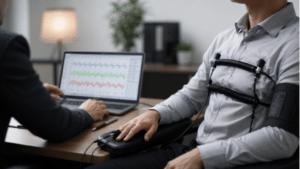

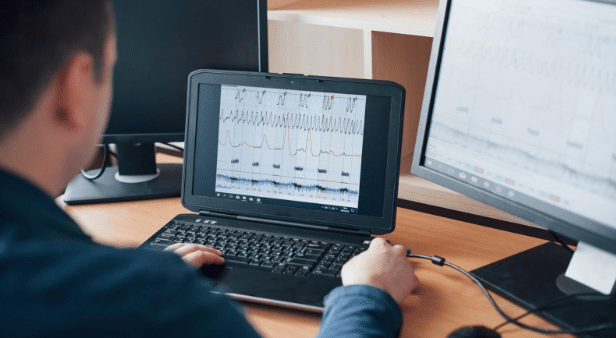
Polygraph evaluation is a rigorous process that requires a detailed, methodological approach. To make accurate inferences, examiners must carefully analyze the physiological data collected by the lie detector machine.
Often, polygraph testing yields substantial information. Examiners are then able to reliably infer honesty or deception based on a professional analysis of the collected data.
However, there are instances where polygraph findings are insufficient to draw meaningful conclusions. Such instances may trigger retests, depending on the matter under investigation.
But what makes polygraph data sufficient?
This post shall help put that question in a better perspective.
What Do Polygraphs Measure?
Lie detectors don’t measure lying literally. Rather, they monitor fluctuations in certain physiological functions consistent with deception.
The modern lie detector instrument mostly measures changes in cardiovascular functions (heart rate, pulse rate, and blood pressure), perspiration, and respiration.
Whenever an examinee responds to questions during the in-test phase, special sensors record the magnitude of their physiological reactions comparative to pre-recorded baseline data. Examiners later analyze this information to deduce honesty and deception.
When Is Polygraph Data Deemed Sufficient?
A polygraph test must fulfill several conditions to yield reliable data, namely;
1. Baseline Data Collection
A polygraph examination follows a structured process consisting of the pre-test, in-test, and post-test phases, all conducted within the same session.
During the pre-test phase, the examiner conducts a detailed interview to explain the procedure, review the issues under investigation, and establish rapport with the examinee. An important component of this phase is the collection of physiological reference data, often referred to as baseline information.
Rather than representing a fixed or absolute physiological “norm,” baseline data serve as comparative reference points. Examiners evaluate how an individual’s physiological responses vary across different categories of questions, rather than comparing reactions to a single universal standard.
To collect this reference data, the examiner attaches the following polygraph components:
- Respiration sensors (pneumographs) to monitor breathing patterns
- Cardiovascular sensors to track blood pressure and pulse activity
- Electrodermal sensors to measure changes in skin conductance
The instrument is calibrated, and a structured sequence of questions is administered. These responses establish response patterns that are later compared during the in-test phase to assess consistency, magnitude, and relevance of physiological reactions.
2. Multiple Question Categories
A good deal of polygraph questioning is carried out during in-test.
However, to gather credible information, the lie detector test questions should take different forms – Relevant, Control, and Irrelevant.
- Relevant Questions
Relevant questions cover the subject matter in a direct manner. Example:
Did you shoot Mr Houston last Saturday?
- Control Questions
Control questions are broad, non–case-related questions used to create a physiological comparison point, helping examiners distinguish normal stress responses from reactions linked to the issue under investigation.
Example:
Have you ever told a significant lie to someone?
- Irrelevant Questions
Irrelevant questions refer to general queries that are asked to calm down the examinees following a rigorous sequence of questioning. Example:
Is your name James?
Photo Credit: iStockPhoto.com
3. Use of Validated Forensic Techniques
Polygraph tests are based on validated and standardized forensic testing procedures with variations typically of the Control Question Test (CQT). The techniques are aimed at comparing physiological responses to relevant questions against responses to comparison or control questions under controlled conditions.
In some investigation cases, the examiners can also use the Concealed Information Test (CIT) or the Guilty Knowledge Test (GKT). The foundation of this approach is that those who have direct knowledge of a crime might have stronger physiological reactions in response to details known only to investigators and the perpetrator.
It is important to note that while the CIT is research-supported, its application is case-specific and less prevalent in regular field investigations because of its requirement for verifiable, non-public crime details.
In order to increase reliability, qualified examiners may also incorporate corroborative investigative aids and structured interviewing measures that would ensure polygraph results are interpreted within a broader evidentiary context rather than in isolation.
Possible Scoring From Conclusive Data
When a polygraph examination produces interpretable physiological data, examiners apply standardized numerical scoring systems across multiple chart recordings. These systems assess consistency, intensity, and distribution of responses rather than isolated reactions.
Based on this analysis, results generally fall into one of the following categories:
- Deception Indicated
A Deception Indicated outcome occurs when physiological responses to relevant questions are consistently stronger than responses to control questions and differ meaningfully from established response patterns.
- No Deception Indicated
A No Deception Indicated outcome suggests that physiological responses to control questions are equal to or greater than responses to relevant questions, indicating no discernible pattern consistent with deception.
These determinations are based on aggregate chart analysis, not on any single question or physiological response.
Photo Credit: iStockPhoto.com
When Is Polygraph Data Deemed Insufficient?
A polygraph examination may be deemed insufficient when the collected data do not support a reliable interpretation. In such cases, examiners may issue either an Inconclusive (INC) or No Opinion (NO) result.
- INC Tests
An Inconclusive result indicates that the physiological data contain conflicting, ambiguous, or inconsistent response patterns. Common contributing factors include:
- Instrumentation or calibration issues
- Examinee fatigue, illness, or heightened emotional distress
- Excessive movement or unstable physiological responses
- Inadequate differentiation between question categories
While the use of countermeasures can contribute to inconclusive outcomes, not all INC results imply intentional interference. Each case requires professional judgment and contextual evaluation.
- NO Tests
A No Opinion finding is issued when the collected data are insufficient or unsuitable for meaningful analysis. This may occur when physiological recordings are erratic or when external factors prevent valid chart interpretation.
Determining whether irregular responses reflect deception, situational stress, or unrelated physiological conditions requires examiner expertise and adherence to professional standards.

Photo Credit: iStockPhoto.com
The Bottom Line
Polygraph tests must yield sufficient information for examiners to give a decisive verdict of honesty or deception. The absence of reliable data may cause the tests to be rendered Inconclusive or No Opinion.
However, it’s what triggers an INC or NO verdict that should worry examinees the most.
For instance, inconclusive findings caused by the detection of polygraph countermeasures can cast aspersions on an individual’s credibility and have them subjected to more intense scrutiny. That underscores the significance of being truthful throughout the polygraph process.
Besides, it’s prudent to have all lie detector tests conducted by qualified examiners.