
Pneumographs are an essential polygraph accessory, working alongside other attachments to collect vital physiological data during lie detector tests. Understanding their mechanics is critical in conducting a credible polygraph exam.
But first, it’s important to know the specific physiological data that pneumographs record.
Here’s a comprehensive guide to how pneumographs work.
Unpacking Pneumographs
Pneumographs are one of the three principal polygraph attachments, designed to collect vital physiological data during a lie detector test.
A pneumograph resembles a corrugated rubber tube or strain gauge. It specifically measures respiratory activity, a critical physiological metric that has been historically used to discern deception.
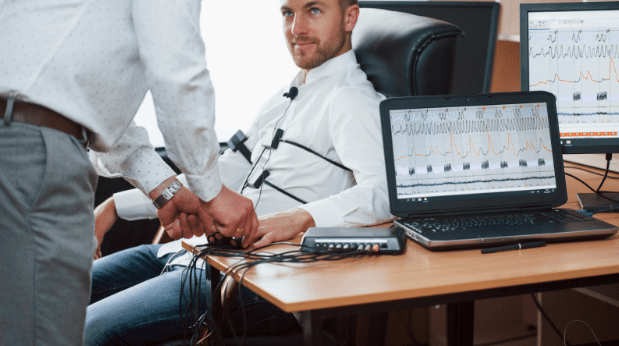
Before a lie detector test, polygraph examiners place pneumographs around an examinee’s body. The appendage goes to the subject’s chest and abdomen, tracking subtle deviations from pre-recorded respiratory baselines.
How Does Lying Impact Respiratory Activity?
Research has shown that lying may lead to slowed breathing. This is known as respiratory suppression, and often manifests as a decrease in breathing amplitude and pace.
According to studies on the psychology of dishonesty, lying causes a spike in testosterone and cortisol reactivity. Both hormones are involved in the body’s “fight-or-flight” response.
An increase in cortisol and testosterone levels should ordinarily cause a corresponding spike in various physiological functions. So, why isn’t that the case with breathing?
Deception exerts a massive cognitive load on the brain. Our brains require much cognitive effort to suppress the truth.
To maintain a heightened state of awareness during deception, an increased intake of oxygen is paramount.
But while you’d expect respiratory rate to spike while suppressing the truth, the converse typically happens during polygraph tests. Slowed breathing is usually the examinee deliberately attempting to mask evidence of abnormal respiratory activity.
How Do Pneumographs Work?
Before polygraph in-test questioning begins, an examiner would need to connect various attachments to an examinee’s body. One such appendage is the pneumograph.
Pneumographs come in twos. As mentioned, one tube goes around an examinee’s chest while the other is placed around their abdomen.
Each tube forms a sealed system that connects to a transducer, which records subtle air pressure changes.
Whenever an examinee inhales during lie detector tests, their thoracic cavity expands. This causes an increase in the volume but a decrease in pressure within the pneumograph tubes.
The converse happens when the subject exhales.
Now, pneumographs record both the respiratory rate (pace) and depth (amplitude).
Special pneumatic tubes convert the collected respiratory data into electrical signals. They then transmit the information to data visualization software integrated into the polygraph machine, typically in real-time.
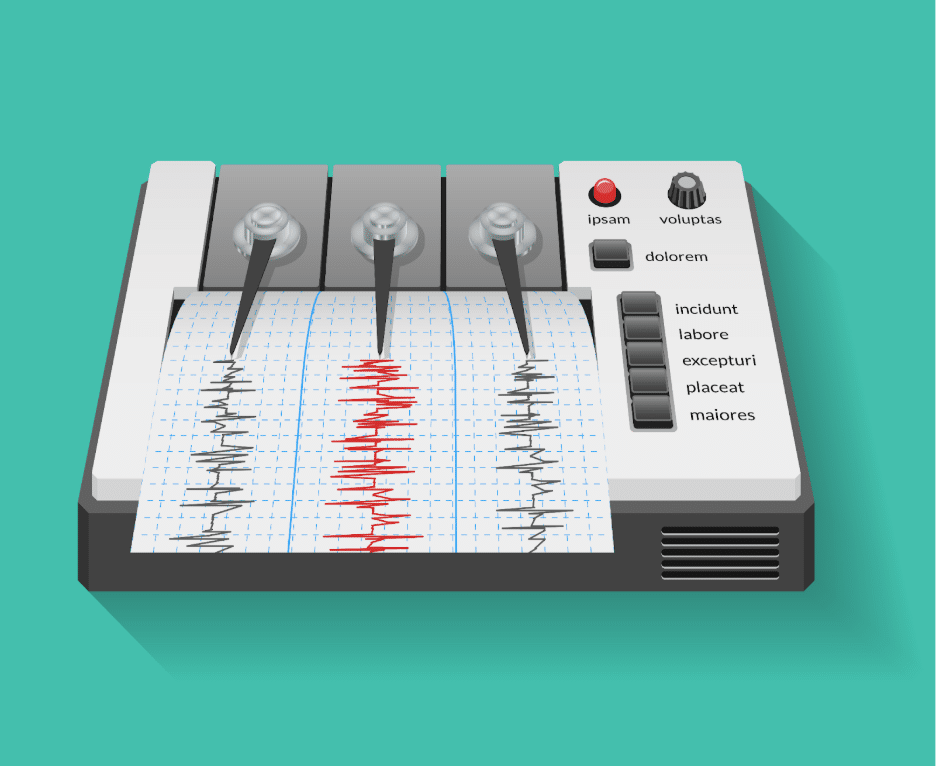
Every dataset appears as wavy lines on a computer screen (for digital polygraphs) or on a pneumogram paper (for analog polygraphs).
Each wavy line denotes your breathing pattern while responding to specific polygraph machines. To infer deception, examiners look out for a stronger magnitude of patterns against pre-recorded physiological data.
Respiratory Changes Measured By Pneumographs
Pneumographs can measure numerous breathing patterns synonymous with lying. While commonly bundled into rate or amplitude, the various respiratory changes during deception include;
- Slow Breathing – Breathing rate decreases due to respiratory suppression.
- Fast Breathing – The “fight-or-flight” response triggered when we lie may increase respiratory activity.
- Shallow Breathing – Breathing becomes less deep.
- Irregular Breathing – A distortion in normal respiratory rhythm, resulting in erratic breathing.
- Suppressed Breathing – A form of physical countermeasure in which an examinee consciously attempts to manipulate their respiratory activity.

Role of Baseline Data
Polygraph tests unfold in three primary phases, including;
- Pre-test phase
- In-test phase
- Post-test phase
Each stage is critical to the success of lie detector tests. In fact, polygraph findings may be automatically rendered invalid if it emerges that an examiner skimped on any of the three phases.
One of the vital events that occur during the pre-test stage is gathering the examinees’ physiological baseline data.
Baselines denote your normal physiological state. Examiners rely on this information to compare the magnitude of responses to the in-test questions, with a significant variance between the two datasets suggesting deception.
To gather baseline data, examiners will connect the various polygraph accessories to an examinee’s body. They properly calibrate every sensor to improve the accuracy of the collected information.
Next, the examiner poses certain non-stressful control questions to the examinee. The data becomes a crucial reference point for analyzing the responses to in-test questions.
What If An Examinee Uses Countermeasures?
The use of countermeasures is pervasive within the polygraph community. However, studies have shown that these techniques simply don’t work.
Part of polygraph training entails equipping examiners with ways to detect countermeasures. During a lie detector test, a polygrapher will look out for evidence of intentional process manipulation, such as erratic pneumograph recordings.
An examiner may also question the examinee directly about the usage of countermeasures.
Note that this question is often unexpected but totally allowed. Therefore, it can easily throw a dishonest examinee off balance and have them admit to engaging in manipulative behavior.
The result? A failed or (at best) inconclusive lie detector test.

Photo Credit: Polytest.org
The Bottom Line
Lying exerts cognitive load on the brain. The resultant mental stress may cause examinees to suppress their breathing, often to manipulate the process.
Pneumographs measure the subtlest changes in breathing rate and amplitude. To infer deception, examiners compare the magnitude of these fluctuations to pre-recorded baseline data.
However, pneumographs don’t work alone. They function alongside other vital polygraph attachments like cardiosphygmographs and electrodermal sensors.
One way to improve the reliability of pneumographs (and relevant attachments) is to invest in an advanced polygraph machine. Besides, have each lie detector test conducted by a duly certified and licensed polygrapher.