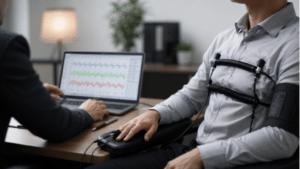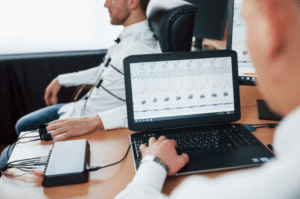


Polygraph examination is a rigorous process that often culminates in careful data analysis.
Before inferring deception, examiners must determine whether the information collected is sufficient to enable accurate interpretation of the lie detector test findings.
Insufficient or inconsistent data may result in an Inconclusive or No Opinion determination, depending on the examiner’s scoring system and professional standards.
Here’s a look at how polygraph examiners evaluate data sufficiency before making their inferences.
Understanding Polygraph’s Mechanism
The initial procedure in the assessment of polygraph data sufficiency is to comprehend what lie detector tests can measure.
Polygraph machines do not detect lying directly. Instead, they examine some physiological alterations that are linked to lying.
Lie detector tests generally evaluate the change in;
- Cardiovascular functions – heart rate, pulse rate, and blood pressure
- Breathing, including respiratory rate and amplitude
- Skin conductivity, usually as a result of excessive perspiration
Polygraph machines are equipped with attachments that measure the different physiological functions.
Cardiosphygmographs record cardiovascular activity, whereas pneumographs record respiratory change. Electrodermal sensors, in the meantime, measure changes in skin conductivity.
Most of the modern polygraph instruments also have motion sensors, which aid in detecting movement of the examined persons that might meddle with the interpretation of data.

Photo Credit: Unsplash.com
Prequalifying Polygraph Examinees
Not every individual is an ideal candidate for a polygraph examination, and certain conditions may affect test suitability or data quality. Failing to adequately assess and examine an examinee’s psychophysiological suitability can significantly compromise data quality and test reliability.
Here are critical factors to consider;
1. Minimum Age
There is no universally mandated minimum age for polygraph testing. However, many examiners and professional associations discourage testing children under 12 due to developmental, emotional, and ethical considerations. Minimum age requirements vary by examiner and jurisdiction.
In addition to ethical concerns, younger children may pose practical challenges that might complicate the attempt to conduct a credible lie detector test. This may include limited cognitive growth in regard to abstract concepts and emotional instability that can influence physiological stability.
2. Consent
Informed consent—often documented in writing—is a standard requirement for ethical polygraph testing. Without proper consent, results may be inadmissible or ethically questionable, depending on the testing context.
3. Physical and Mental Soundness
An extensive assessment of an individual’s physical and mental condition is critical before subjecting them to lie detector tests.
Extreme fatigue and certain respiratory or cardiovascular conditions, such as asthma or hypertension, may influence physiological responses and complicate data interpretation.
Certain physical or psychological conditions may affect physiological responses and complicate data interpretation. Examiners typically assess these factors during the pre-test phase and may postpone or modify testing when reliability is a concern.
While polygraph tests do not measure psychological stress directly, heightened anxiety can amplify physiological responses recorded during the examination.

Photo Credit: Unsplash.com
Ensuring Data Sufficiency During the Procedure
Test Preparation
In-depth preparation determines the quality of data obtained during lie detector tests.
Note that the polygraph procedure unfolds in three critical steps, namely pre-test, in-test, and post-test, which often occur in a single session. Much of the preparation occurs during the pre-test phase.
First, polygraphers conduct a mock exam known as an acquaintance test. This preliminary examination familiarizes the examinee with the procedure, minimizing in-test nervousness.
In addition, the acquaintance test helps examiners assess signal responsiveness and ensure sensors are functioning properly. It helps adjust the sensors and forestall equipment malfunctions during the in-test phase.
Preparation also entails establishing an examinee’s baseline data.
In polygraph testing, baseline data reflect an examinee’s physiological responses to neutral or comparison questions used for analytical reference. It serves as a benchmark for comparing reactions to the stressful (Relevant and Control) questions asked during the in-test phase.
In-test Questioning
Most polygraph examiners utilize the Control Question Technique (CQT).
CQT involves asking a series of Relevant and Control queries during in-test questioning.
Relevant questions address a subject matter directly. Example: Did you steal from your sister last Monday?
Meanwhile, control questions are designed to elicit concern or uncertainty, often relating to past behaviors similar in theme to the issue under investigation.
Besides the CQT technique, examiners may deploy other approved questioning methodologies like the Concealed Information Test (CIT).
Also called the Guilty Knowledge Test (GNT), the CIT approach involves questioning an examinee about intimate details about the incident under investigation. Individuals with concealed knowledge may exhibit stronger physiological responses to crime-relevant details than to neutral alternatives.
Drawing Inference
At the end of a polygraph test, examiners carefully analyze the physiological data collected during the in-test phase.
Note that each response to in-test questions elicits a physiological reaction recorded by the lie detector machine. Those responses are captured by various sensors connected to the polygraph equipment – cardiosphygmographs, pneumographs, electrodermal sensors, and motion sensors.
Examiners then apply validated numerical scoring systems to assess response patterns and determine outcomes such as Deception Indicated (DI) or No Deception Indicated (NDI).
A DI inference results from a stronger magnitude of response to relevant than control questions, while the converse is true for an NDI conclusion.
Where data is insufficient, a polygraph evaluation may result in an Inconclusive (Inc.) or No Opinion (NO) verdict.

Photo Credit: Unsplash.com
The Bottom Line
Sufficient data is the cornerstone of a credible lie detector test. If a polygraph machine records conflicting or inconclusive physiological information during in-test questioning, it becomes exceedingly challenging for examiners to make accurate inferences of deception.
Industry standards emphasize objective scoring methods designed to minimize examiner bias and base conclusions on recorded physiological data. Rather, they should spring from verifiable data recorded by the lie detector equipment and analyzed in accordance with the industry standards.
We hope you can leverage the above data evaluation insights as you plan for your next lie detector test.
Ultimately, reliable polygraph outcomes depend on thorough examinee preparation, proper equipment setup, standardized questioning techniques, and adherence to recognized professional guidelines.